Government
Residents Challenge SUN Trail Route Along A1A Beach Boulevard
Members of St. Augustine Beach Citizens for Safety, a resident-led group that formed earlier this year, say they support the larger goal of creating a connected trail system but are asking St. Johns C
By Heather Vreeland
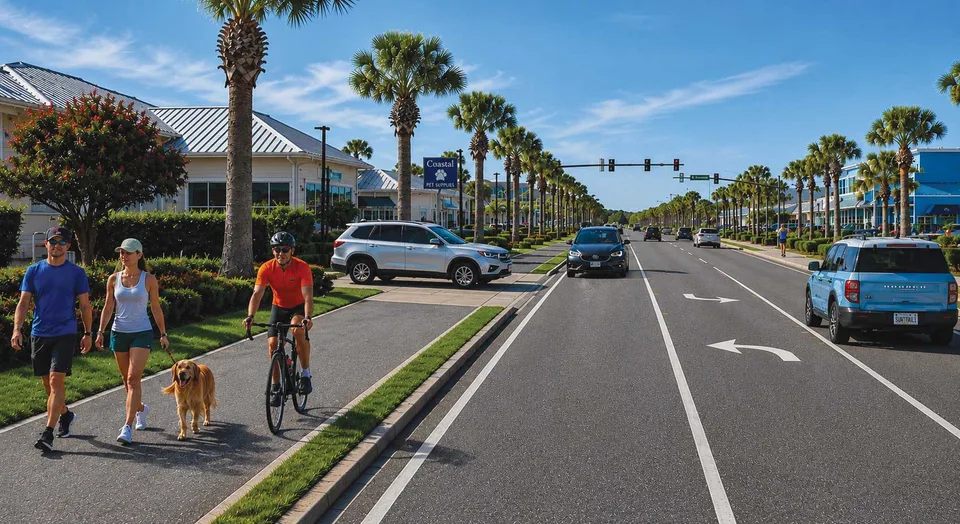
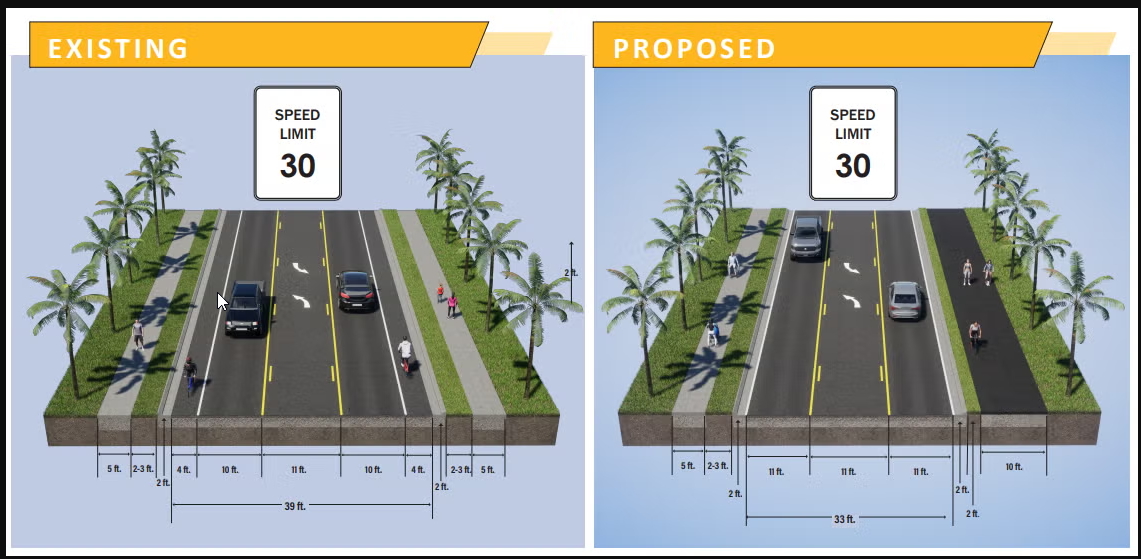
Members of St. Augustine Beach Citizens for Safety, a resident-led group that formed earlier this year, say they support the larger goal of creating a connected trail system but are asking St. Johns County to reconsider the approximately 10-foot-wide shared-use path planned along the east side of Beach Boulevard.
Their concerns center on traffic, emergency access, the number of driveways and intersections along the route, conflicts among bicyclists and pedestrians, and the potential impact to the boulevard’s distinctive row of palm trees.
“We are not trying to stop the SUN Trail,” resident Linda Hover said during an interview with St. Augustine Social. “It’s a great idea. This is just a really bad location.”
Hover said she first learned details of the project almost by accident in October 2025. As landscape chair for Sea Colony, she noticed survey flags along the east side of Beach Boulevard and initially assumed they were related to utility work. According to Hover, her neighborhood’s landscape contractor asked surveyors about the markings and learned they were connected to the SUN Trail project. Hover then contacted the City of St. Augustine Beach and began researching the proposal. She said residents did not fully understand the scale of the project until a public meeting at the Anastasia Island Branch Library earlier this year. That meeting, she said, prompted residents from several beach neighborhoods to organize as St. Augustine Beach Citizens for Safety.
While the group believes residents should have been more involved earlier, the City of St. Augustine Beach said the project has been publicly considered for years.
“The City Commission in 2019 approved the Sun Trail when it passed Resolution 19-11,” the city said in a statement provided to St. Augustine Social. The commission also heard a project presentation at its March 2, 2026 meeting and resident opinions during its May 4 meeting, according to the statement.
“At neither of the 2026 meetings did the Commission change its original approval of the project,” the city said. “The residents have had ample opportunity to be heard.”
One of the residents’ biggest concerns is the number of places where the proposed path would intersect with driveways, neighborhood entrances, businesses and side streets. Hover said the group has counted approximately 58 crossing points along the Beach Boulevard route. That becomes particularly concerning, residents argue, because vehicles exiting properties already must move toward the roadway to see approaching traffic.
Rich O’Brien, a Beach Boulevard business owner participating in the group, said his hotel and miniature golf property can generate roughly 400 vehicle trips on a busy day.
“Right now you have to pull out five feet across the sidewalk to see,” O’Brien said. With a wider trail located between the property and roadway, he worries drivers may be across much of the shared-use path before they can clearly see traffic on Beach Boulevard.
“Are people going to yield the right of way, or are they going to hit you, or are you going to hit them?” he asked. “It’s very unsafe.”
Resident Susan Daily described waiting approximately two-and-a-half minutes recently to turn left from Sea Colony onto Beach Boulevard because of vehicles entering and leaving nearby properties along with bicyclists already crossing the neighborhood entrance. Residents question what those movements will look like if pedestrian and bicycle traffic increases on a two-directional shared-use trail.
The group is also questioning how changes to the roadway could affect emergency vehicles. Residents said they have been told existing shoulders along portions of Beach Boulevard would be eliminated or modified to accommodate the trail and roadway configuration. They argue those shoulders can currently provide additional room when motorists need to move aside for emergency vehicles. Hover cited more than 4,400 emergency responses from the St. Augustine Beach fire station near the pier during 2025, though that figure was supplied by the group and has not been independently verified by St. Augustine Social.
Residents also question placing conventional bicycles, faster electric bicycles, pedestrians, children, dog walkers and people pushing strollers together on the same bidirectional path. Heidi Hamstein said the project was conceived years before the explosive growth in e-bike use now being seen throughout the community.
“You’re proposing to put e-bikes and pedestrians and bicyclists all on one path,” Hamstein said, arguing that residents have not been given enough information about how those users will safely interact.
The group also questioned whether serious road cyclists would choose the shared-use path at all, particularly because cyclists would encounter frequent street and driveway crossings. Their argument is that the trail could substantially alter the boulevard while some faster cyclists continue riding in the roadway.
Perhaps the most important distinction in the group’s position is that its members are proposing an alternative rather than asking the county to abandon the SUN Trail. They point to an earlier route studied using Mickler Boulevard, where a wide existing path already provides part of an east-west greenway.
Under the residents’ preferred concept, the trail could travel from Santander Street to Pope Road, continue along Mickler Boulevard and ultimately reconnect using streets such as 11th Street and State Road A1A. Riders seeking beach access could still travel east on Pope Road, 11th Street or other connecting streets. Residents argue that route would require less new infrastructure and contain significantly fewer driveway and street conflicts. Hover said previous route analysis itself found Mickler to be safer but favored Beach Boulevard because it provided stronger connectivity to destinations.
That tradeoff, direct access versus fewer conflicts, is at the center of the current debate.
“We’re not saying don’t build it,” Hamstein said. One option, she said, is to leave the existing Beach Boulevard section largely as it is and route the regional trail differently through the beach community.
The potential impact to the line of palms along Beach Boulevard has also become an emotional issue for residents. Group members fear excavation, construction and asphalt installed close to root systems could damage trees even if they are not immediately removed.
The City of St. Augustine Beach, however, says it has been assured the palms will remain.
“Concerning the palm trees: I’ve been told by Greg Caldwell, Director of Public Works at St. Johns County, that the trees will not be removed,” City Manager, Max Royle said in its response.
Royle emphasized that St. Augustine Beach does not control A1A Beach Boulevard. “The road is owned and maintained by the County,” Royle said. “Any decisions concerning changes to it are made by the County.”
He directed residents with project questions to county officials involved with the SUN Trail project.
For members of St. Augustine Beach Citizens for Safety, that means their effort now is focused less on stopping the regional trail and more on persuading St. Johns County to reopen the discussion about where this particular segment belongs. They believe there is still time to find a route that accomplishes the larger goal without introducing new problems along an already heavily traveled beach corridor.
As Hover put it, “We hope they understand we are not trying to stop the SUN Trail.” They simply want the county to reconsider its path.