Government
License Plate Readers Draw New Scrutiny While Solving Crimes in St. Johns County
For nearly a decade, cameras positioned along St. Johns County roadways have quietly photographed passing vehicles, read license plates and given law enforcement another tool for finding stolen cars,
By Heather Vreeland
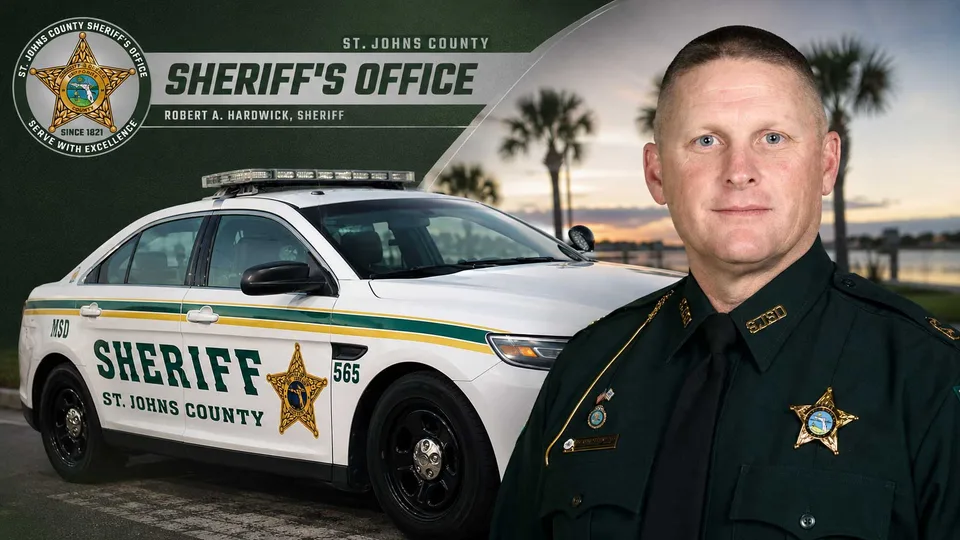
For nearly a decade, cameras positioned along St. Johns County roadways have quietly photographed passing vehicles, read license plates and given law enforcement another tool for finding stolen cars, wanted suspects and missing people. For most of that time, St. Johns County Sheriff Rob Hardwick says few residents seemed particularly interested in them.
“We’ve had ours since 2017,” Hardwick said during an August interview with St. Augustine Social. “We’ve been using them for so long and no one’s cared about them.” That has changed.
Several residents used the public-comment period of the St. Johns County Board of County Commissioners’ Aug. 4 meeting to raise concerns about Flock Safety cameras and automated license plate reader technology, questioning everything from the size of the network to who can search the information it collects.
At the center of the debate is a basic tension increasingly playing out in communities across the country: How much information should law enforcement be able to collect in the name of public safety, and what safeguards should accompany technology capable of documenting where vehicles travel?
Resident Deborah Campbell told commissioners she was submitting a petition carrying more than 200 signatures and called for the county to address the technology publicly.
“We are asking the board to halt mass surveillance in our county,” Campbell said. “True safety and freedom go hand in hand.”
Campbell asked the commission to require public hearings and a commission vote before similar surveillance technologies are purchased or tested with public money.
Another resident, Brian Seymour, told commissioners he had personally counted approximately 14 license plate readers within a mile of his Martinique Circle home. “I can’t go anywhere,” Seymour said. “I literally cannot leave my house without being tracked by one of these things.”
But Seymour also posed what may be the most measurable question raised that morning.
“I’d like to see some numbers on how many crimes have been solved, how many missing persons have been found exclusively through the use of these cameras,” he said.
Hardwick has numbers.
According to statistics he provided during our interview, St. Johns County Sheriff’s Office use of license plate reader technology in 2025 contributed to the recovery of 55 stolen vehicles and 37 stolen license plates, the location of 36 wanted people and 28 missing people, and the clearing of 131 felony charges and 70 misdemeanor charges. Hardwick said many of the misdemeanor cases involved organized retail theft along the Interstate 95 corridor.
“We are solving crime in St. Johns County every single day with our license plate readers,” he said.
Hardwick says the Sheriff’s Office’s choice of Flock was intentional. Flock Safety is an American company founded in 2017 and headquartered in Atlanta. The company has become one of the country’s largest suppliers of automated license plate reader systems. Hardwick said what mattered to him was both the company’s domestic ownership and the agency’s ability to control its information.
“The data is mine,” Hardwick said of SJSO’s system. “I own it and I release who it actually goes to.”
He also stressed what the Flock cameras are not doing. The cameras used as license plate readers do not employ facial recognition, he said, and are not connecting to motorists’ cell phones or Bluetooth devices. Instead, they capture an image of a vehicle traveling on a public roadway and make vehicle and plate information searchable for investigative purposes.
Hardwick also pointed to restrictions on who inside his own agency can access the system. He said he personally does not have credentials allowing him to search the database because he does not have the required National Crime Information Center access. NCIC is a federal criminal-justice database with access restrictions.
“I cannot look at LPRs,” Hardwick said. “I have no login, no password.”
Concerns about misuse are not imaginary, however. Cases elsewhere in the country involving improper searches have fueled the recent national debate over automated license plate readers. Flock recently announced additional safeguards, including reducing its default retention period from 30 days to seven days and requiring stronger auditing and case-linked searches for law-enforcement users.
Hardwick said SJSO has not had an internal violation involving its system.
To Hardwick, the debate changes considerably when the technology is viewed from the perspective of a victim waiting for investigators to find someone.
During the interview, he rattled off examples. A double homicide committed execution-style near the TPC entrance was solved with help from license plate reader technology, he said. Investigators used the system in the case of an 11-year-old girl who was abducted near a bus stop and sexually assaulted; Hardwick said the investigation eventually identified multiple victims between St. Johns and Flagler counties. In another case, the technology helped officers identify a double-murder suspect fleeing Mississippi; deputies intercepted the vehicle near Interstate 95 and State Road 16.
He also described using readers to locate missing people, including those suffering from dementia or considered suicidal.
But one case the cameras couldn’t solve may be the example that stays with him most. Years ago, a bicyclist was struck and killed by a vehicle on State Road 214 west of St. Augustine. The driver fled. Investigators knew approximately when the collision occurred. Evidence recovered at the scene indicated the vehicle was likely a Ford pickup truck. But investigators could never identify the driver, Hardwick said.
The case remains unsolved. Hardwick continues to stay in touch with the victim’s mother. “She wants it solved, and I wish we could solve it,” he said.
Had the network that exists along that corridor today been operating when the crash occurred, Hardwick believes investigators could have searched vehicles traveling through the area within the known time window and quickly narrowed the universe of possible trucks. “If we had the license plate reader technology where we have it now on 214, we could have solved it in less than 45 minutes,” he said.
That, Hardwick argues, is what can get lost when the conversation is reduced to cameras and databases.
“Sometimes you’ve got to be a victim, or have someone close to you that’s been hurt, to understand the value” he said.
Hardwick strongly rejects the characterization that deputies are routinely following law-abiding residents around the county.
“We don’t care,” he said bluntly of ordinary motorists who trigger cameras while going about their day.
For investigators, he sees automated readers as the modern version of something officers have done for generations. Earlier in his career, Hardwick said deputies drove through parking lots manually typing license plates into computers looking for stolen vehicles or wanted people.
“This is no different than doing that,” he said. “It’s quicker, better technology.”
In a public statement on the Sheriff’s Office Facebook page Hardwick said “License plate reader technology is an essential tool helping to keep St. Johns County safe. As sheriff, I took an oath to defend the U.S. Constitution and protect our community. We uphold both by using proven technology lawfully and holding our personnel accountable for proper use.”